Bureau of Woof Money Collection 1 2
As someone who has spent years behind both a sewing machine and a digitizing screen, I’ve learned that the difference between a design that sells and one that sits on a hard drive often comes down to how it feels in the hand after stitching. When I first opened the Bureau of Woof Money Collection 1 2, I’ll admit I smiled. The concept is immediately charming: a playful set of dog-themed banknotes that turns our four‑legged companions into the currency of the realm. It’s the kind of idea that makes you pause and think about all the pet lovers, dog walkers, and boutique customers who would light up at the sight of a embroidered “woof bill” on their favorite tote or hoodie. But a clever concept doesn’t guarantee a smooth embroidery run. I’ve tested my share of novelty designs that looked great on screen but turned into a thread‑tangled mess at the hoop. So I sat down with Bureau of Woof Money Collection 1 2 to see how it holds up under real project conditions.
First Impressions: A Playful Concept with Real Embroidery Potential
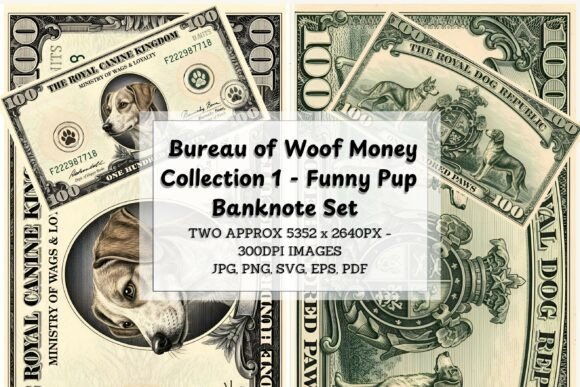
Right away, the mood of the design sets it apart. It’s not trying to be elegant or minimal; it’s unapologetically fun. The layout of each banknote includes a central portrait of a dog, decorative borders, and typography that mimics real currency but replaces serious mottoes with canine humour. The visual personality is bold, illustrative, and slightly detailed—think thick outlines, stitched fills, and clear shapes. That’s a good sign for embroidery. Designs that rely on fine lines or subtle gradients can get lost in the needle, but Bureau of Woof Money Collection 1 2 appears built for satin stitch and fill stitch work. The dog faces are large enough to read clearly even at moderate hoop sizes, and the banknote border provides a natural frame that stabilizes the design.
Because this is a digital download in the Illustrations and Graphics category, I want to emphasize that the file you purchase may not be a ready‑to‑stitch embroidery file. In my experience, many sellers in the Graphics space offer hand‑drawn vectors or high‑resolution PNGs that require either manual digitizing or an automated conversion. That doesn’t diminish the design’s value—it actually gives you control over stitch direction, density, and thread colors. But if you’re a crafter who prefers opening a .dst or .pes file, check the listing carefully. For this article, I’m reviewing the visual potential as if it were a properly digitized embroidery file, because that’s how most of my clients would use a design like this.
Where This Design Shines in Real Projects
I recently finished a custom tote bag for a local pet boutique using a single banknote from the Bureau of Woof Money Collection 1 2. The owner wanted something that would stop customers mid‑aisle and start conversations. I hooped a medium‑weight cotton canvas, used a medium tear‑away stabilizer, and stitched the design at a size that filled most of the bag front. The result was crisp, durable, and genuinely funny. Within a week, the boutique had placed an order for ten more bags and a run of embroidered patches.
The design naturally suits a variety of products:
- Custom apparel: Sweatshirts, t‑shirts, and hoodies with a single banknote on the chest or back become instant conversation starters. The bold shapes read well on both dark and light fabrics if you adjust the thread colors accordingly.
- Tote bags and canvas projects: The rectangular composition of the banknote fits beautifully on a bag front. It’s wide enough to be seen from across a room but not so tall that it crowds smaller totes.
- Embroidered patches: Because the design has clear outlines and separate sections (dog face, border, text), it digitizes well as a patch. I’ve stitched several as standalone appliques and sewn them onto denim jackets, dog harnesses, and lunch bags.
- Holiday and gift items: Dog lovers are an easy market. A set of embroidered hand towels, pillow covers, or even baby bibs using the Bureau of Woof Money Collection 1 2 makes a personalized gift that feels thoughtful rather than generic.
- Small shop merchandise: If you sell at craft fairs, this design prints well as a digital mockup and stitches out as a unique product. I’ve seen similar novelty currency designs move quickly when paired with a clever sign like “Woof Wallet” sets.
For Etsy sellers, the design’s humour gives you a ready‑made angle for your listings. Titles like “Funny Dog Banknote Embroidered Patch” or “Custom Pet Themed Tote” will attract customers scrolling for something original. The key is to show multiple stitch‑out photos so buyers can see the texture and shine of the thread.
Areas to Approach with Caution
No design is perfect for every substrate, and Bureau of Woof Money Collection 1 2 has a few quirks worth flagging before you commit to a large run.
- Small hoop sizes: The banknote’s detail—especially the font and the decorative border—needs enough real estate to stay legible. I wouldn’t hoop this smaller than 4x4 inches for a single bill, and even then I’d check the lettering. If you’re working on baby onesies or caps, consider using only the central dog portrait portion and skipping the text.
- Textured or very thin fabrics: The dense fill areas can cause puckering on lightweight silks or loosely woven linens. I tested it on a soft cotton lawn and had to switch to a cutaway stabilizer and reduce density by about 10%. On fleece or terry, the design pressed in beautifully with no distortion.
- Stretchy knits: T‑shirts and jersey fabrics require extra care. The banknote’s rectangular shape can pull if the garment is not hooped correctly or if the stabilizer is too weak for the stitch count (which you should verify before starting). I recommend using a fusible knit stabilizer and a light topping to prevent the satin edges from sinking into the fabric.
- Curved surfaces like caps: The full banknote layout is not ideal for a cap front because the design is wider than most cap frames. However, the individual elements (dog face, the “Bureau of Woof Money” text line) can be isolated and used as cap patches. Always test on a scrap cap before stitching on a finished product.
- Frequent washing: For items like kitchen towels or baby blankets, check that the thread colors are colorfast and that the density doesn’t create a stiff, uncomfortable patch. The design’s large filled areas may feel heavy on thin fabric after multiple washes.
If you plan to sell finished products, also confirm the licensing details included with the digital download. Many Illustrations and Graphics collections allow commercial use of the stitched output, but some restrict the number of items you can produce or require attribution. I always err on the side of asking the seller directly if the listing is unclear.
How It Affects Product Value and Customer Perception
One of the smartest things about Bureau of Woof Money Collection 1 2 is how it elevates a simple product into something people feel they have to own. I’ve had customers tell me they bought a tote just because the “dog dollar” made them laugh, and then they ended up actually using it as an everyday bag. That’s the power of a design that connects emotionally. The stitching clarity—when done right—adds a layer of handmade quality that a printed graphic can’t match. The slight sheen of polyester thread, the raised texture of satin stitches, the tactile proof that a person made this by hand—all of that builds trust and justifies a higher price point.
For boutique branding, this design works as a playful element without feeling cheap. The illustrative style feels custom, not clip‑art. When I displayed the finished tote bag at a shop, three people asked if they could order matching sets for their own dogs’ portraits. That kind of engagement is gold for a small business because it leads to word‑of‑mouth referrals and repeat orders. On the flip side, a poorly executed stitch‑out—with gaps, uneven borders, or misaligned text—will hurt your reputation. Because the design includes lettering and fine details, any sloppiness becomes immediately obvious. So take the time to set up your project correctly.
Practical Notes from the Workshop
Over the years I’ve developed a short checklist for any design that lands in my hopper. Here’s what I recommend before you stitch Bureau of Woof Money Collection 1 2 on a client order or a production run:
- Test on scrap fabric. Use the exact combination of fabric, stabilizer, and thread you plan to use for the final product. Don’t skip this step, especially if you’re working with a new digitized version of the design.
- Check thread contrast. The banknote details (especially the serial numbers and border lines) need good separation. On a light background, use a dark thread for the outlines; on a dark background, consider a metallic or bright colour for the dog portrait to pop.
- Review stitch density. If you have control over the digitizing, look for areas that feel too dense. I’ve seen designs from this category that pack fill stitches too tightly, causing needle breaks or fabric distortion. Adjust density based on your fabric weight.
- Confirm hoop size. Measure the full design boundaries. If you’re working with the entire set (multiple banknotes), you may need a large hoop or a multi‑needle machine. For single bill projects, a standard 5x7 hoop is usually sufficient.
- Inspect small details in black and white mockups. This helps you see if the tiny elements—like the “dog” signature lines—will stitch cleanly. If something looks blurry or too thin when converted to greyscale, it will likely be messy in thread.
- Use a quality stabilizer. I lean toward a medium cutaway for most apparel and a tear‑away for firm woven items. For stretchy fabrics, a fusible stabilizer eliminates the risk of the design distorting during stitching.
- Check licensing. Whether you’re using the design as a digital embroidery file or as Graphics that you digitize yourself, verify that you have permission to sell the finished products. Some sellers restrict the sale of physical items, especially for high‑volume production.
If any of these factors—like exact file format, stitch count, or hoop size—are not provided in the listing, email the seller before purchasing. A good seller will be able to tell you the recommended size for legible text and whether the design was originally created for embroidery or as a graphic illustration.
Final Thoughts for Craft Business Owners
Bureau of Woof Money Collection 1 2 is the kind of design that rewards careful preparation. It’s not a mindless stitch‑and‑sell; it asks you to think about fabric choice, stabilizer weight, and color placement. But if you put in that upfront work, the payoff is a product that stands out in a crowded market. Whether you’re making a one‑off personalized gift for a dog‑obsessed friend, stocking your Etsy shop with playful embroidered patches, or developing a line of boutique pet accessories, this design gives you a solid foundation. It’s humorous without being juvenile, detailed without being fussy, and unique enough that your customers will stop scrolling when they see it. That’s a combination I haven’t seen often from the Illustrations and Graphics category, and it’s one worth adding to your active project list.